AI Quality Engineering Is Rising Faster Than the Labor Market Can Name It
When I first started at Arctic Wolf, the team was already standing up a dedicated AI quality engineering group and moving some of our most talented engineers into it.
The more you build agents that run production level work, the more there is to keep right. Models get updated. New capabilities ship. Customer environments change. Any one of those can change how a system behaves on cases it used to handle well. Building fast without building the quality discipline alongside it just means more of your time eventually goes to debugging and dealing with quality issues in production.
Our systematic investment into AI quality is paying off, and a lot more companies are beginning to realize the same need.
Agents Are Moving Into Processes That Already Run the Business
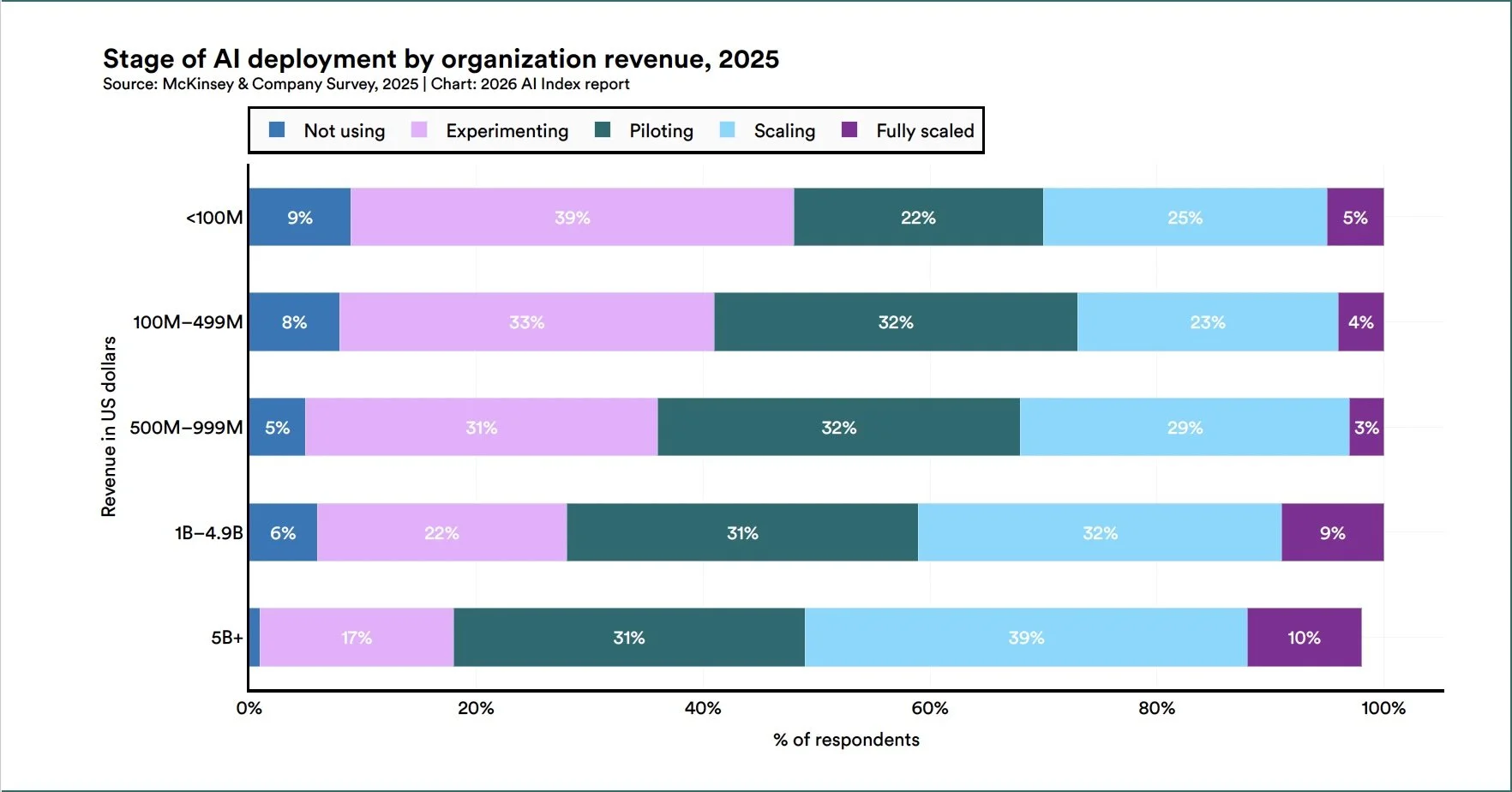
Stanford AI Index 2026, Chapter 4, Figure 4.3.6: "Stage of AI deployment by organization revenue”
The experimental phase of AI adoption is ending. Stanford's 2026 AI Index reports that among organizations above $5 billion in revenue, 39% are scaling AI and 10% are fully scaled, with only 17% still experimenting. Agent deployment sits earlier on that curve and is moving fast: in the technology sector, scaled agent use has reached 24% in software engineering, 22% in IT, and 21% in service operations.
Deloitte's survey of more than 3,000 business and IT leaders puts the trajectory plainly. Today 23% of companies use agentic AI at least moderately, and 74% expect to within two years. Their report also captures what changes when that happens, noting that "failures that were learning opportunities in pilots become business risks in production."
An agent inside a business process produces actual business outcomes. A claim paid, a case closed, a customer answered, a ticket resolved. Each of those is a business event with a record attached, and a wrong outcome is wrong in the operational sense. The same agent that delivers business value carries business risk
The Business Moves, and AI Systems Have to Move With It
AI systems are initially validated against a snapshot of the business as it stood on the day the evaluation set was built. Businesses do not hold still, though. A policy changes somewhere upstream, and the agent is now deciding cases the evaluation never covered. It carries on doing what it learned to do, and doing it correctly, inside a business that has changed around it.
Ordinary software announces this kind of problem. Change a schema and something throws an error. An AI system stays quiet and keeps returning confident answers that used to be right, which is how drift runs for months before anyone notices.
The interesting failure mode in agentic systems has nothing to do with whether the agent is any good. It comes from the distance between the business the agent learned and the business it is working in today.
None of this is new. Google researchers described it in 2015, in a paper on technical debt in machine learning systems that has aged unusually well. They wrote that these systems "interact directly with the external world" and that "the external world is rarely stable," and that ML carries "a special capacity for incurring technical debt" on top of every maintenance problem ordinary code already has.
This is the debt I would worry about. Accumulated wrong decisions sitting inside processes the business depends on, made by a system nobody has been measuring, surfacing months later as churn, rework, or a compliance finding.
Deloitte covered this issue in their September 2026 analysis: "Traditional QE processes cannot validate autonomous AI systems without continuous evaluation. Quality spans the engineering life cycle, not just post-deployment remediation." That is why the work belongs to a standing function instead of a release gate. Someone has to keep asking whether a system that was right in March is still right in September, against a business that has moved on.
What the AI Quality Discipline Consists Of
I'm lucky to lead a team that has built this. My colleague Ankit Jain wrote up how we did it in a piece I'd highly encourage reading in full, Engineered for Trust: How We Built the AI Trust Engine. It covers the five checkpoints behind the AI Trust Engine that powers our Aurora Agentic SOC.
We build golden datasets out of real cases our experts have already resolved, so a candidate change can be scored against outcomes we know are right long before a customer sees it. Every change runs against that benchmark offline first, and we look at how the agent reasoned rather than only what it concluded. Once something is live, a separate model grades every response against a fixed rubric. Autonomy comes in stages after that. An agent runs silent, then recommends, then acts, and it moves up only when the evaluation says it has earned the promotion. Analysts correct what they see along the way, and every correction goes back into the datasets.
That last point is more important than it looks like it is. Golden datasets are only as good as how current they are, and a benchmark built from last year's data tells you whether the system still handles last year's business. Ours grows every time an analyst corrects a decision or an agent escalates something it has not seen before, which keeps the benchmark moving at the same speed as the work.
You Can See the Market Reaching for This. It Has Not Converged.
Here is where the job data gets interesting. The work is growing fast, but it is growing as a skill spreading into existing roles rather than as a single clean job title.
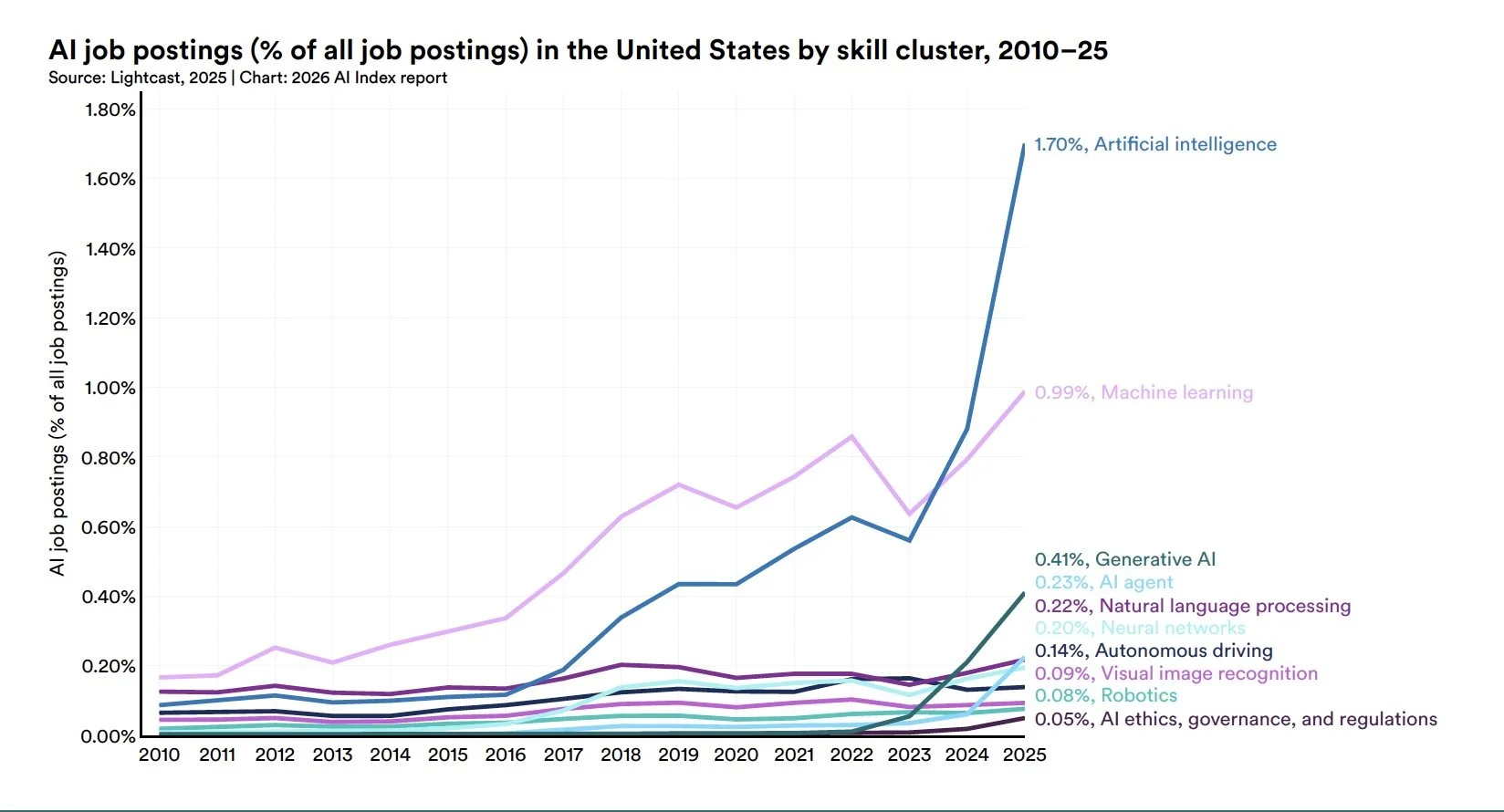
Stanford AI Index 2026, Chapter 4, Figure 4.4.3: "AI Job Postings (% of all job postings) in the United States by skill cluster, 2010-25”
The AI Index's economy chapter, built on billions of US postings, puts the artificial intelligence skill cluster in 1.70% of all US job postings, with a new agentic cluster at 0.23% after exponential growth in a single year. The fastest-growing specialized skills are the ones for running systems at scale: workflow management up 818% against the 2013 to 2015 baseline, scalability up 733%, Amazon Web Services up 1,358%.
The frontier labs treat evaluation as senior work. Anthropic's "Research Engineer, Model Evaluations" role describes its mandate as turning "ambiguous notions of 'intelligence' into clear, defensible metrics", and OpenAI runs an entire eval job family.
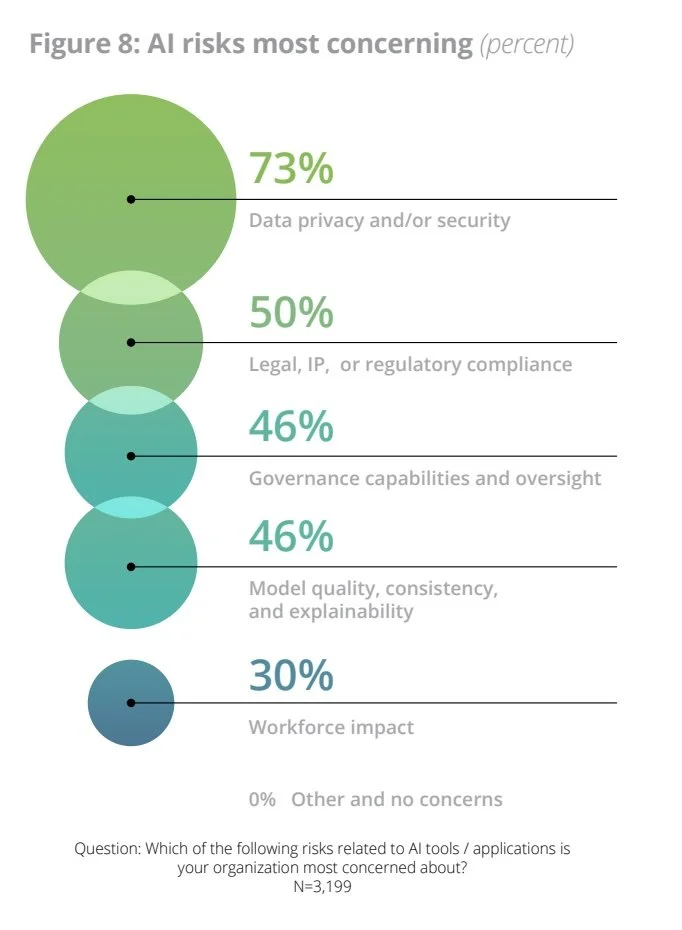
Deloitte, The State of AI in the Enterprise The untapped edge 2026, Figure 8: AI risks most concerning (percent)
But no source cleanly isolates "AI Quality Engineer" as its own titled occupation with a documented growth rate, because the work hides under a dozen labels: applied scientist, eval engineer, AI reliability engineer, agent reliability engineer, trust engineer, quality engineer. Evaluation, validation, and testing appear nowhere in the top ten specialized skills.
Deloitte's leaders rank model quality, consistency, and explainability among their top concerns at 46%. Gartner expects more than 40% of agentic-AI projects to be cancelled by the end of 2027, driven partly by inadequate risk controls. Regulation is codifying the work as well, since the EU AI Act's high-risk obligations, the NIST AI Risk Management Framework's Measure function, and the ISO/IEC 42001 management standard all require ongoing evaluation and monitoring.
Understand It, Then Reward It
The gap closes through deliberate choices inside organizations. In my experience the work only sticks when it is a real career, with a valued job profile, a promotion path, and senior people in it. Quality engineering treated as overhead gets staffed with whoever happens to be free, and the engineers who turn out to be good at it leave for teams where building things is what gets recognized. If you want agents running processes your business depends on, the people making sure those agents are right have to be as visible as the people who built them.
A few questions I would sit with:
Does someone own your evaluation infrastructure as a platform, or does every team choose their own adventure?
Are your golden datasets built from real production work, and do they grow and change over time?
Do your agents earn autonomy in stages, or do they ship straight to acting on their own?
When the business changes, does anything re-verify the agents against the new reality, or do they keep running against the evaluation you did at launch?
When a provider releases a new model, do you already know how it compares, or do you find out in production?
This space is going to keep growing, and quickly. Agent adoption is still in the single digits across most business functions, so most of the processes agents will eventually run are still run by people today. The organizations that build the quality discipline while the stakes are still moderate will be the ones ready to trust agents with the important processes later.
Is AI quality treated as its own discipline at your company, or is it still spread across teams without a clear home? I'd love to hear how you are structuring it.
